

Opportunity:
Land Between the Lakes is a national recreation area managed by the U.S. Forest Service, straddling the border of Kentucky and Tennessee, where families come to camp, hike, fish, and connect with the outdoors. When LBL set out to develop a Children’s Forest, the project had a name and purpose but lacked a defined shape. Over nine months, Canopy worked with the team to generate and pressure-test concepts, engage the community, and build a financial case — arriving at a specific, grounded vision that LBL can bring to funders and partners to turn this concept into a reality.
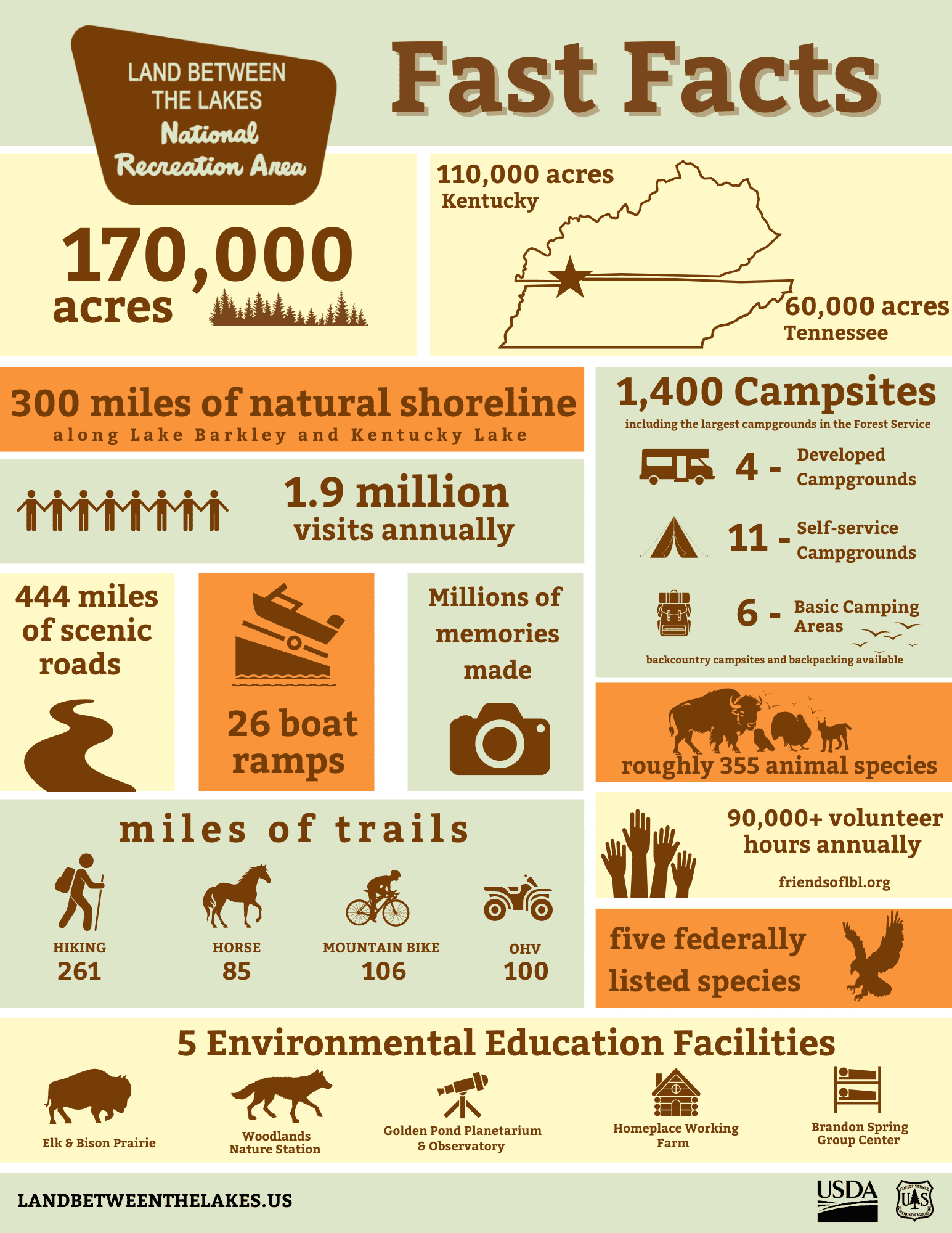
Image credit: landbetweenthelakes.us
Project Highlights:
Defining a Clear Concept
The Children’s Forest entered the planning process without a defined concept — just a name, a purpose, and a site. That made this a different kind of engagement: Our work wasn’t to articulate an existing organization’s direction, but to generate possible experiences from scratch, test them with the community and data, and determine which were worth pursuing. We produced 4–5 draft concepts in the Discovery phase, refined them through community engagement and peer benchmarking, and ran financial projections on the strongest options before selecting a final direction. The result is three interlocking experiences — a nature playground and ball run, an environmental education program called Forest 101, and a lakefront glamping campground — that together project a 19% increase in LBL attendance over ten years.
Centering Children through Community Engagement
A children’s experience shaped without children’s input would have missed something important — so we organized a roundtable specifically for Lyon County 4th graders, who contributed ideas and priorities directly to the concept development process. Other sessions engaged regional tourism leaders, educators, and members of the Between the Rivers community, who have deep and longstanding ties to the land. One-on-one interviews extended the reach further, drawing in contacts at Murray State University, state and federal partners, and supporters from across two states. The breadth and intentionality of this engagement shaped a vision that reflects the full range of people the Children’s Forest is meant to serve.
A Vision Backed by the Numbers
Because the Children’s Forest is a new initiative requiring real capital investment, the vision plan needed to make a financial case alongside the programmatic one. As such, we tested all three recommended experiences against a financial projection model. The nature playground and ball run is projected to generate roughly $82,000 in average annual net income and drive a 31,000-visitor increase to the adjacent Nature Station in its opening year. The glamping campground is expected to produce approximately $550,000 in concessionaire fees over its first five operating years. These projections give LBL a credible case to bring to funders and the Forest Service as the project moves forward.
Result:
The Children’s Forest Vision Plan is built for forward motion. More than a planning document for internal use, it gives LBL a clearly defined concept, a tested rationale, and a financial case to share with funders, sponsors, and federal partners as the project moves from vision to reality. The plan captures what the community said, what the data showed, and what LBL is committing to — making it equally valuable for external advocacy and internal decision-making.
“Finding a path forward in mission delivery can sometimes be so difficult as to feel like a ‘mission impossible.’ Ensuring that your plans are truly engaging for stakeholders, are financially viable, and tailored in such a way as to allow for flexibility in the future is a big ask. Often, or perhaps even mostly, we find ourselves lacking the in-house expertise to even begin. For me, this is exactly the spot Canopy fits in the puzzle. Expertise, buy-in, caring, and professionalism set them apart and have left me grateful for getting to know them. They truly became part of our team and community, and I look forward to working with them again in the future.”
— Jim McCoy, Area Supervisor, U.S. Forest Service