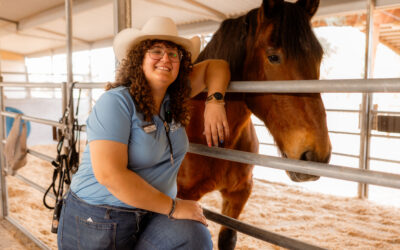
The Advancing Minority Leadership in Aquariums & Zoos Program (AMLAZ) is now in its second year, and Canopy is proud to continue our sponsorship of this vital leadership development opportunity in partnership with MIAZS and Leadby.
We interviewed Dr. Sinlan (Sheila) Poo, Curator of Research at the Memphis Zoo, to hear about her experience in the program thus far, her leadership growth, and her goals for the future.

What inspired you to apply to the AMLAZ Program?
My experience in MIAZS inspired me to apply for the program. I’m moving forward in my career and have always been interested in leadership positions, so I’ve been looking for opportunities in different leadership programs. I attended the AZA Leadership Foundational Program, but this one felt different.
I’ll share something personal here: I faced a very difficult situation with someone I supervised. I was told the conflict was because of my identity, which made it especially challenging. The situation was tricky, but my organization was very supportive and ultimately handled it well. This happened recently, and it brought to the surface something I had always known — that many organizations, and individuals, don’t always have the resources to fully support minority leaders.
So I was excited to see the AMLAZ Program and what it had to offer. After my recent experiences, I started looking more proactively for ways to improve my management skills and acquire tools to address these issues. This was a big part of why I applied to this program.
What appealed to me most was the chance to connect with other minority leaders and those on their way into leadership — the middle group that’s moving up. I was looking for something more tailored than a general leadership course, and AMLAZ seemed like the right fit.
What has been a highlight of the program thus far?
I think the highlight for me was hearing Lori Perkins (Canopy’s Vice President) speak. I don’t know her personally, but she’s someone I’ve admired from afar, so I was very excited she was going to join us.
Listening to her share her path as a leader — the challenges she has faced both externally and internally — was powerful. The internal aspect especially stood out. She was very generous in sharing openly with the group, knowing it was a safe space for her as well as for us.
It prompted me to reflect on my own experiences. Of course, there are obvious systemic challenges, but she also helped me recognize some of the subtler ones — the difference between something that’s structural and something that feels like a personal inadequacy or obstacle to overcome.
Hearing from someone just a few steps ahead of you is incredibly inspiring, and that was definitely one of the highlights for me.
How has the program helped you grow as a leader?
I think the program has helped me grow as a leader in very practical ways. I really appreciate the strategic, hands-on side of it: actual steps you can take to resolve an issue or move it forward. While I value the more philosophical aspects, I’m very goal-oriented. I like concrete guidance. For instance, if you’re in a certain situation, here are some resources you can use; if you’re building a program, here are things you might not have considered. That combination of zoo-specific and broader leadership strategies has been especially helpful.
The part I’ve gained the most from, though, has been the one-on-one coaching sessions with Laura Martina. The structure of the course includes online modules, reflection, and group discussions. The group discussions are great for connecting with peers and realizing you’re not alone in facing challenges. But for me, the coaching sessions have been the most valuable. They let me dig into the details of a situation and come away with very specific next steps.
Every time I meet with Laura, I leave with pages of notes — direct, actionable insights. Even if she doesn’t know the exact people I should reach out to, her advice sparks the thought: Okay, this is the next step. This will make my IDP stronger. This will make me a more well-rounded leader.
Another important aspect has been the networking. Talking with others from AZA, connecting with people from Canopy, and building those relationships has been incredibly helpful as I think about my next step. Our positions are often unique within our organizations, so it’s valuable to know others who are in similar roles and a little further along in their careers. Those partnerships and connections are something I really look forward to.
What are your professional or leadership goals for the future?
My goal over the next three to five years is to move into a leadership position at a zoo. Right now, I serve as the Curator of Research: a role that was created specifically for me as I was moving up. I’ve noticed similar positions starting to expand at other zoos, and I see my next step as something like Chief Conservation Officer or Chief Research Officer at a zoo or aquarium. I have a pretty clear sense of the direction I want to go and what I’m aiming for.