Kentucky Science Center is a premier destination for family fun activities in Louisville, KY. With daily programming for children, families, and adults, the Science Center plays an ongoing role in the region as a resource for caregivers and teachers, a gathering place for the science community, and a chosen source of entertainment for all.
A few years ago, their team began looking into the possibility of expanding to create a second location in nearby Bowling Green, and they engaged Canopy in 2024 for a feasibility study to determine the best path forward for this exciting ‘blank slate’ project.
Mike Norman, President & CEO of Kentucky Science Center, shares an inside look at how Canopy’s economics team helped guide this ambitious project to expand access to science education across Kentucky.
The Background: On Kentucky Science Center’s impetus for expansion
Canopy: Can you tell us about Kentucky Science Center’s evolution and what led you to consider expansion?
Mike Norman, CEO: We’re based in Louisville, Kentucky, right on the river. About 14 years ago, we were just the Louisville Science Center trying to serve the whole state, which was very parochial. We were named by the State General Assembly as the State Science Center in the early 2000s, and we decided to embrace that name and run with it. It opened so many doors and got us outside of Louisville. In 2012, we officially changed our name to the Kentucky Science Center.
I’m all about meeting people where they are. Geographic and socioeconomic barriers shouldn’t keep people from learning about and loving science. In Kentucky, less than half of our kids are ready for kindergarten when they start, and that follows them throughout their whole academic career and impacts their earnings for the rest of their life. It’s really significant. So in partnership with PNC, we launched Science in Play, our early childhood education initiative. We redid our entire first floor (about 15,000 square feet) and launched two traveling exhibits that we placed in libraries around the state.
When COVID hit, every library shut down. We had these two exhibits and thought: What are we going to do? We put one in a mall here in Louisville — I got space for like a dollar per square foot. Our PNC partners saw it and suggested taking the second one to Bowling Green, which is about an hour and a half south of us. When I went down there and met with the chamber president, his first question was: “What’s it going to take to get you open permanently here?” We hadn’t even thought about it. But the response was so positive, we really started toying with that idea.
The Project: On feasibility and letting the market guide decision-making
What drove your decision to embark on a professional feasibility study?
I started reaching out to business leaders in Louisville to gauge interest. We also used a student group from Western Kentucky University for market research — we needed boots on the ground because this wasn’t our community and we didn’t know all the nuances. The students were great and able to connect with the community in ways we never would have otherwise, but we still needed something really foundational…
So I reached out to folks in the science center industry asking who I should talk to. Canopy’s name came up, and I eventually connected with Zach Winfield (Canopy’s Senior Vice President). He asked, “How big do you want the site to be?” I said, “It’s a blank slate. We don’t know what we don’t know.” We knew we didn’t want to just replicate what we have in downtown Louisville. We wanted it to be very unique for the market, but also sustainable.
Zach shared that this was a novel approach for a feasibility study because you let the market tell you the right size and scale for the facility. How did that work?
That’s exactly right. When Zach started showing me early data and some of the analytics your team can do with cell phone usage, I was amazed. (I’m a finance guy, so I’m a data geek.) In one of our preliminary calls, Zach started pulling up places in Bowling Green to show me analytics that were quickly available. He showed me some of the attractions there, and I thought: Holy cow, this is great.
What I really appreciated was Zach’s insight beyond the data. He picked up on hesitancy from our team — they were worried we’d cannibalize the Louisville site to stand up the Bowling Green site, and that they’d have to run back and forth between locations. Zach and I had really good conversations about staff concerns he was picking up on, which allowed me to address it directly with leadership and comfort them.
That’s nowhere in the study deliverables — that Zach’s going to do that for us — but you could tell he really cared that this project was going to be successful. It wasn’t just: Here’s a report, and now we’re done with you. He wanted to see this happen for us.
What did the feasibility study help you accomplish?
This was really a go/no-go decision. Once we had the study, I went back to key stakeholders and said, “Here are our assumptions; what do you think?” It was really good because they’d say things like, “Nobody’s going to pay to park, so take that $50,000 annual revenue line out.” But then they’d say, “You’re way undervaluing the demand for camps and school field trips. This region has nothing, so you’ll be it.”
Those kinds of tweaks weren’t like: This is never going to work and you have no idea what you’re talking about. They were fine-tuned adjustments, and stakeholders said, “Yeah, we can do that. This is supportable — it’s sustainable. Where are we going to build it? Let’s go.”
I still use and quote Canopy’s feasibility study to this day. Having that professional study to lean back on — it means it’s not just me coming from Louisville with a big idea. There are professionals saying: Here’s what we can do. That carries a lot of clout.
When I did reference calls to other organizations before we started with Canopy, people said, “You’re going to get a whole lot more value than just a study.” And that’s absolutely true.
The Future: On project progress and advice for other organizations
Where does the project stand now?
It has gotten really exciting. We’re partnering with the Warren County Public Library, which is an incredible library system in Bowling Green. They’ve outgrown their space; we need space. We’re serving the same audience, so we said, “Let’s do this together.”
We’ve selected a site and worked with developers to create renderings. Recently at the Association of Science and Technology Centers (ASTC) Conference, the library folks went with me. While there was a lot of concerned talk about federal funding, we were saying, “This is really positive. Look what we’re going to change.” If you put libraries and science centers together, we can really make this work.
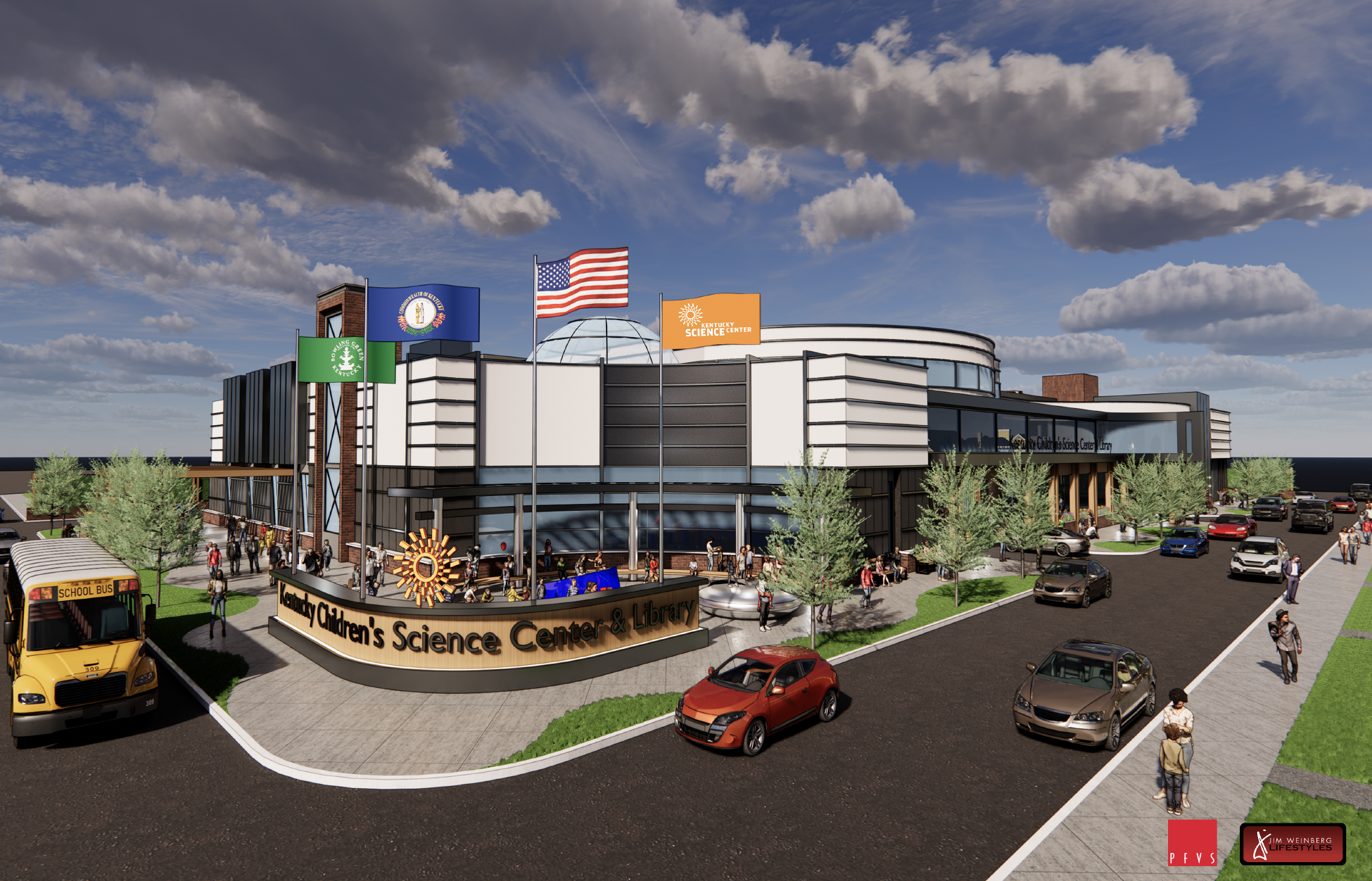
Rendering credit: Kentucky Science Center, PFVS, Jim Weinberg Lifestyles
When you arrive as a family, you’re going to know you’ve arrived somewhere very special. We’re still working out details, but I’m really excited about it. When you think about legacy at the end of your career, this is transformative for our entire state. We’re going to lift up that whole region, and the impact for kids in the future will be really cool.
The scale has grown from what Canopy originally recommended because we added library space and other needs. The area we’re in is part of a larger development with a public park, so in five years it’s going to be amazing.
What would you say to other organizations considering a similar project?
You need a feasibility study, and you need the right professionals to do it. For anybody trying to do a visionary, transformative project, you’ve got to have the data — but you’ve also got to have the professionals who know what the data means and how to present it.
The community we’re building in has historically been heavily minority populated and has gotten squeezed out over the years. We had community sessions before ever announcing anything — we went to them and talked to them. Having that feasibility study to lean back on helped us communicate: “There are professionals saying: Here’s what we can do, and here’s how it will work.” You have to have the data to back up the dream.