By: Gabe Buckley
Multiple news outlets have reported on NOAA and NASA’s finding that July was the Hottest Month on Record. Watching Phoenix hit 115 degrees for more than a week had us all feeling the heat. Here at Canopy Strategic Partners we asked the question, ‘does this intense heat drive away visitors to zoos and botanic gardens, while concentrating visitors at indoor venues like aquariums?’
To answer that question, we used our cutting-edge Audience Analytics platform to look at foot traffic and analyzed the months of June and July to see how the extreme July heatwave may have impacted Year-over-Year visitation. Here’s what we found.
- Of the 200+ zoos and aquariums accredited by AZA we track across the country, attendance was up 4% over the same months (June + July) last year.
- Within the 110+ APGA member public gardens that we monitor, attendance was up nearly 8%.
This seems to reject the hypothesis that the increasing heat would push down overall visitor numbers. But – this whole picture of the whole country forgets the fact that for some, July was actually a cooler month than average.
Upon closer examination we found that the intense climate shift experienced by the Southwest region did have profound effects on seasonal visitation trends for a number of organizations, especially once you consider the seasonality of all the organizations involved. However, that trend wasn’t exactly what we expected.
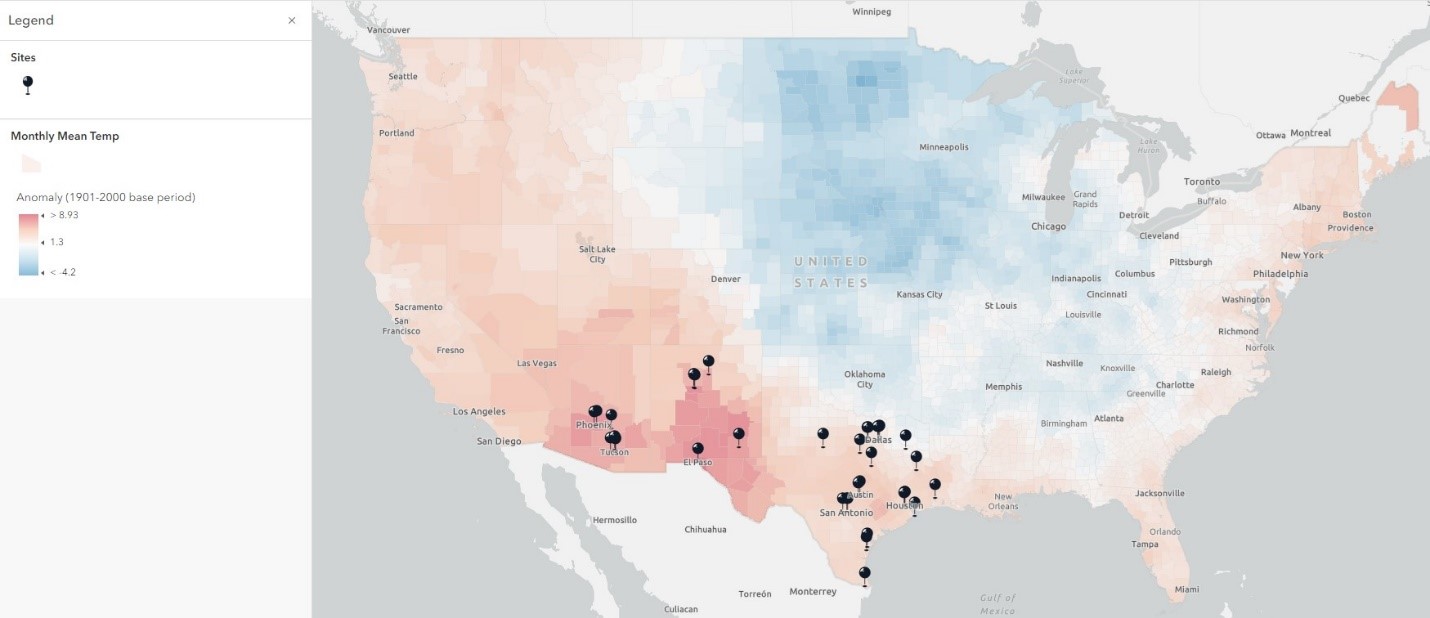
The map below shows the 5 aquariums, 16 Botanic Gardens (or Arboretums / Nature Centers), and 16 zoos across Texas, New Mexico, and Arizona we analyzed for this quick snapshot of visitation Year-over-year. The darkest red areas on the map indicate places where the mean temperature for July was several degrees higher than the 1901-2000 base period mean. Blue areas on the map show that the middle of the country was actually several degrees cooler than normal during the month of July. Knowing that our drastic swing into El Nino has also caused climate chaos, we started to look closely at the variation these different sites experienced.
First, we separated Zoos and Botanic Gardens from Aquariums (Mostly Outdoor vs Mostly Indoor) in the Southwest region, we found that outdoor venues were up 20% year-over-year, while the 5 aquariums sampled were up an average of only 12% year-over-year. How could this be? With extreme July temperatures, we expected zoos and botanic gardens to lose visitation to aquariums and other indoor attractions.
Then, we mapped out visitation trends for the past two years for all 37 organizations. Right off the bat, a clear qualitative trend emerged from the data. In the first week of June 2023, 30 of the 37 organizations we sampled gained visitors over the first week in June of 2022. The 7 organizations that were negative were barely negative – 2023 visitation was only a few percentage points off from 2022 numbers. The second and third week of June looked similar.
By the end of June, things started to look a lot different. In the final week of June, 22 of the 37 organizations we followed saw large year-over-year decreases in their weekly visits. Many saw less than half the visitors they usually got. This trend carried through the weeks of July, with the last two weeks of July showing especially high attendance deficits.
To gain even more insight, we reached out to a zoo who we’ve worked with over the years. Bonnie Mendoza, COO/CFO at the Phoenix Zoo, confirmed that Phoenix experienced this trend. June 2023 was a little milder than usual in Phoenix, and the Zoo saw a huge year-over-year attendance bump. As temperatures rose consistently above 110 degrees, the Zoo reviewed guest traffic patterns and in a move to make sure their animals, guests, and staff remained safe, shifted to a closure before the noon hour. By the end of July the attendance losses added up and July as a whole was less than half of what it was the year before.
However, Bonnie also reminded us of something very important – July is not exactly peak season in Phoenix, Arizona. While the world was captivated by the record highs Phoenix saw this year, temperatures above 100 degrees are hardly out of the norm. Of their more than 1.1 million visitors, Bonnie informed us that July usually only accounts for about 25,000 of those visits. Because of the relatively small impact of July, Bonnie noted that the losses from the heat averaged out with the gains from June to leave Phoenix up about 3% across both months.
July is, however, a peak month for most of the aquariums in the region. Even before any temperature change is considered, audiences in the Southwest are already staying inside in the summer. As an organization, it becomes important to not only recognize how climate change may affect your visitors but also when climate change may affect your visitors. 50% losses in the off-season are nothing compared to 50% losses during your peak-season. So, a 12% gain in peak season for the aquariums is still much larger in absolute terms than a 20% gains we saw in many of the outdoor attractions over the same two month period.
This led us to two conclusions: 1) Heat does drive people indoors – but we already knew that. However, climate change affects each region differently. This makes it incredibly important to analyze the long-term trends in your local market. 2) While the extreme heat affected different organizations at different times and caused massive attendance losses over specific weeks, the overall trend was still positive.
Compare the numbers from the Southwest with the 4% increases seen in the AZA and the 8% increases seen across the APGA, and the hypothesis that increasing heat events will dissuade visitors to outdoor attractions starts to fall apart. In fact, published research measuring the effects of temperature (and other factors) on visitation came to a very similar conclusion. In the scientific analysis of the impacts of climate change on visitors, authors found that despite the negative effects of increasing precipitation and heat extremes, overall visitation to the study park was expected to increase due to climate change. The park under study was in Canada, but as we’ve seen from the data provide by Phoenix Zoo, losses in one month can be supplemented by more pleasant weather in other months. Climate change is just that – a change we need to adapt and be resilient to.
While climate change and weather extremes are certainly something to consider, there are many factors to consider as you look to project attendance changes. When you start layering on the effects of exhibit changes, other attractions in your market, demographic changes, and other confounding factors, it can be hard to separate out the true effects of any one visitor influence.
A shifting climate is not something we can control as an individual organization, but we can try to look at the full picture and all the data available to craft a good strategy to combat the effects climate change will have on your visitors. Understanding the changes within your local community is critical in how you might mitigate negative and uncontrollable influences. For some organizations, there may actually be a fairly large benefit – climate change could bring you more visitors. It all depends how global patterns have been affecting and will continue to affect your region in the years to come, and your ability to react and adapt to those changes.
That’s why it becomes so important to monitor your visitors and their visitation patterns – there can be big upsides in recognizing the trends in your market and being the first to deliver on new audience preferences and behaviors. As we head into August, strange weather trends are continuing, bringing unusual heat and precipitation to various regions. Follow our newsletter to see how these regional and national trends shake out.
Contact Canopy today to start a detailed Audience Analysis of your organization and start seeing if your assumptions about your visitors stand up to the data test!