Welcome to our Planning 101 series: designed to demystify the planning process, address what’s included in different types of plans, and prepare you to start strategic planning and/or business planning with a clear sense of what to expect. In this series of articles, we’ll break down the different plan types, how to get ready to plan, and the roles and responsibilities of key players along the way.
First up: Let’s talk about the different plan types. Planning lingo can be confusing and overwhelming when you’re deciding what kind of plan your organization needs. Whether you need help divining your financial future or charting a strategic vision for the next five years, being able to describe the support you need will get you on the right path faster.
What is the difference between strategic planning, business planning, and integrated planning, and how do you know which process is right for your organization?

What is Strategic Planning?
Strategic planning offers an opportunity to make sure everyone is on the same page about the vision, goals, and path for growth. A strategic plan articulates your organization’s shared direction over a specific time frame — often 3-5 years. When the planning process is designed correctly, it can strengthen your team’s bonds and your relationships with stakeholders.
You can expect the strategic planning process to include:
- A review of your guiding statements (mission, vision, and values) to confirm that they express your purpose effectively and work well to help you make decisions.
- An assessment of your organization’s successes and struggles, opportunities for growth, and priorities for change.
- The establishment of goals for the next five years that will help you fulfill your mission and address your challenges.
- A plan for how to accomplish your goals.
You may need a strategic plan if…
- You’re ready to chart the course for organizational change or growth.
- Your organization has changed leadership or is undergoing a significant organizational shift.
- Your current plan is due to expire and/or you need to prepare for an accreditation process.
A typical strategic plan contains:
- Mission, vision, and values statements.
- Goals that represent your areas of focus for the next five years.
- Tangible, measurable objectives that show how you’ll deliver on those goals.
Average timeline for strategic planning: 7-9 months
What is Business Planning?
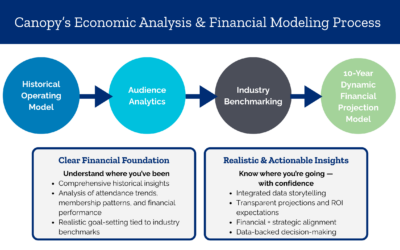
There is no mission without margin: Business planning is a process by which an organization charts a path over time toward an economically healthy and sustainable future. A business plan uses financial modeling to show how your organization can expect to perform over time. By analyzing extensive data on your organization’s past performance, along with the expertise we can share from working with hundreds of your peers, we build a model that credibly predicts the impact that different changes will have on your bottom line.
You can expect the business planning process to include:
- A thorough review of your organization’s financial and operational history.
- A comprehensive benchmarking process by which your organization is compared to peer organizations locally and nationally.
- A strategic assessment of key revenue programs.
You may need a business plan if…
- You’re ready to align your programmatic decisions with your financial goals.
- You’re considering building a new experience or venue.
- You’re thinking of making a change in your operations, such as changing your membership program or moving to dynamic pricing.
- You want to ensure financial sustainability, particularly as it pertains to the vision and goals laid out in your strategic plan.
A typical business plan contains:
- Dynamic scenario modeling to evaluate the potential impact of your operational choices under tens of thousands of possible conditions.
- An organizational profile that deeply investigates the question of how much attendance your market can reasonably support, how that might change in the future, and where you should focus your efforts to drive the gate.
- Strategies to maximize your most impactful economic levers and identify gaps in your economic portfolios.
Average timeline for business planning: 4-5 months
What is Master Planning?
Master planning is a design exercise led by an architect or designer that lays out the long-term, ideal use of a site. The process takes your current map and plans out how to use the spaces to best deliver on your mission and the kind of experience you want to provide. A master plan is usually on a longer timeline because it’s based on capital investment and a building timeline.
Canopy doesn’t offer master planning as a standalone service, but we support master planners by collaborating with design partners to integrate our business planning process with their master planning process. Our goal is to make master planning smarter, more efficient, and a better investment by supporting the client’s best interests with a data-driven approach.
If our team is supporting a master planning process, you can expect…
- Representation of your financial interests in design discussions.
- Hard questions about the ROI on design concepts.
- Quantitative data on the potential performance of the proposed master plan.
Average timeline for master planning (including build timeline): 10+ years
What is Integrated Planning?
Canopy’s innovative integrated planning process pulls together three major plan types: strategic, master, and business planning. Integrated planning involves collaborating with both the Canopy team and a design partner.
You can expect a comprehensive integrated planning process to include:
- Setting strategy first, so it can inform…
- What gets designed in the master plan, which is informed by…
- A business plan that demonstrates how what you build will fulfill your strategic and financial goals.
You may need an integrated plan if…
- You know you’re going to tackle all three of these processes. Integrated planning makes for more informed decision-making and is more efficient: Each partner learns from the other and doesn’t have to review process outcomes after the fact.
A typical integrated plan contains:
- Mission, vision, values, goals, and objectives.
- A master plan, including images of revised site layout or renderings of potential new experiences.
- A business model demonstrating the financial impact of the master plan over the timeline of its build-out.
Average timeline for integrated planning: 10-12 months
Many of Canopy’s clients engage our strategists for multiple planning engagements. If you’re not sure what type of plan you need, we always recommend starting with a strategic plan (or integrated plan) before moving into a business plan.
Ready to get started? Still have some questions about what you need? We’re always happy to help; send us a message and we’ll get back to you right away.
Stay tuned for our next edition: Are You Ready to Plan? We’ll cover a checklist of items to consider and prepare ahead of time so that you can make the most of your planning process.