
January 24, 2019

What does an “average” organization look like? (Part 2 of 3)

In case you missed our last post (check it out here), this is Part 2 in a series of blogs we’re putting together to summarize the findings of a recent research study we completed.

The goal of the study was to gather and consolidate data from a group of partner organizations in AZA (Friends groups, Foundations, Societies, etc.) in order to extract meaningful information about how they operate, and to quantify their operations in aggregate. Fourteen different organizations participated and submitted historical data, amounting to 70 discreet years of financials and other operating metrics to unpack.

In this post, we’re sharing a big chunk of our findings. In the graphic below, you’ll see a range of metrics that quantify what the group averages (or in some cases, medians) looked like.
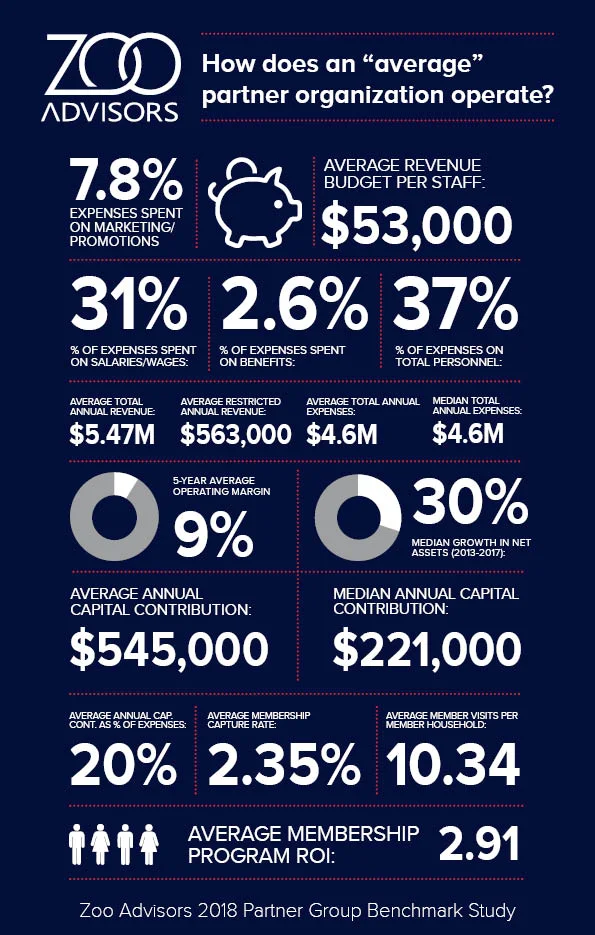
How does your organization compare? Is your membership program generating a good ROI? Are you spending enough on marketing? Are your personnel costs out of control? This is valuable information that you can use to compare/contrast the operating success and challenges of your own organization. 

This is only part of the picture and if you’d like to learn more about the study, or talk about how Zoo Advisors can help you achieve your goals, drop us a line here and we’ll get back to you soon!

Recent Insights

The Benchmarking Trap: Why Cultural Organizations Need to Experiment More

The Benchmarking Trap: Why Cultural Organizations Need to Experiment More

Benchmarking is incredibly useful in business and strategic planning, but there’s a downside that doesn’t get talked about much. When the industry’s comfort zone shrinks, caution turns into conformity and safety turns into sameness. A level of risk is necessary if cultural organizations want to survive — and that means experimenting beyond the benchmark.

read more
Data-Driven Decisions: Turning Audience Insights Into Strategic Growth

Data-Driven Decisions: Turning Audience Insights Into Strategic Growth

Do you have clarity around who’s walking through your gates, who’s not, and where the opportunities lie? Learn how Canopy uses audience analytics and mapping tools to align mission and margin, empowering cultural attractions to make data-driven decisions that support strategic growth and impact.

read more
From Vision to Viability: Integrating Business and Master Planning for Cultural Organizations

From Vision to Viability: Integrating Business and Master Planning for Cultural Organizations

A bold design concept needs a practical foundation — one that connects mission and margin, creativity and feasibility. That’s why the process of integrated planning is so valuable for cultural organizations. In this conversation with Unknown Studio’s Partner & Co-Founder, Claire Agre, we discuss collaboration, client readiness, and the evolving role of design in shaping sustainable, connected places.

read more

Dr. Frederick Lahodny

Even though using “lorem ipsum” often arouses curiosity due to its resemblance to classical Latin, it is not intended to have meaning. Where text is visible in a document, people tend to focus on the textual content rather than upon overall presentation.