Last month, we held the first of four webinars and focused on the role mission-based cultural attractions play in our communities and what that should look like as we move into the future. In this second webinar, we continued the conversation focusing on conservation more broadly. Dr. Jackie Ogden, along with co-host Dr. Kira Mileham, the Species Survival Commission’s Director of Strategic Partnerships, were joined by panelists:
- Silvia Alvarez-Clare, PhD, Director of Global Tree Conservation, The Morton Arboretum
- Christopher Kuhar, PhD, Executive Director, Cleveland Metroparks Zoo
- Valerie Peckham, Public Programs Manager at John James Audubon Center, Audubon Mid-Atlantic
Read on for takeaways from our discussion on whether we’re doing enough for conservation, whether they’re the right things, and if not, what we should be doing:
We started the conversation by asking our audience’s opinion on our conservation efforts:
1: Are we doing the best we can on a scale of 1-5? (1 = “definitely not “and 5 = “absolutely yes”)
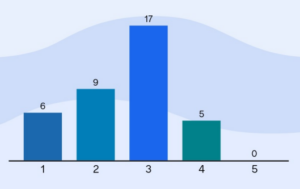
Audience responses
2: If no, what should we be doing?
We received 44 answers, with answers ranging from ensuring conservation efforts are rooted in social and environmental justice, to creating deeper investments and more dedicated staff time, to connecting with our communities, to focusing on education and advocacy. Click here for the complete list of responses.
We then shifted the conversation to our panelists, focusing first on our current state:
- AZA organizations are already spending $200M/year, with defined contributions from member institutions outlined in the AZA ARCS Report to measure input. How do we quantify what we’ve done? We’re primarily measuring “outputs” at this point; should we measuring “outcomes” – actual impact?
- How do we differentiate ourselves? We have the power to mobilize people toward collective action. Create the message from the perspective of the issues. Use the stories of the animals to explain the issues, with climate as the biggest issue.
- Society isn’t doing enough. We need to be bold to maximize impact. We have the majority of the knowledge, scientists, etc. within our organizations, and the opportunity to go beyond our institutions to partner with other organizations (small and large) and our communities – in ways that can be measured.
- We’re doing a lot to justify ourselves, but there are such large environmental issues – we’re even seeing new environmental terms – bomb cyclone, climate change, etc. Clearly, we need to do more.
- Typically, our institutions cover much of the overhead and that makes our money have greater impact. Zoos and aquariums are often “closer to the ground,” so we can monitor our impact in smaller projects, especially local conservation projects where we’re better able to monitor our success.
What Greater Efforts Need to Occur?
- We must pivot to people as well as animals and the environment and start in our own backyards.
- Social justice organizations are already doing this work in Providence, RI
- “We also need to think about the balance of our work (or tension) between rescue, breeding, and SAFE projects. We have the ability to connect our local populations in a much greater way to rescue. I also realize this tension is hard within AZA to get our heads around.”
- We have to consider behavior change in a meaningful way.
- Banning straws is insufficient – we must move beyond single behavior changes. That said, for some, individual behavior changes like banning straws, talking about composting, and minimizing food waste may be the only step some can take while others may be at a stage of addressing behavior changes more systematically. As an example, in the Cleveland community, many are struggling to get to school and hold their job. Conservation is a luxury for them. The Cleveland Metroparks Zoo becomes a place of calm and to enjoy the outdoors.
- This is why conservation and social justice need to intersect more. If we can take care of people, give them agency, then people can take care of the planet.
- We need to identify relevant and realistic gateway behaviors that meet communities where they’re at. But the trick is finding those actions that also truly can scale to drive large-scale impact.
- Some individuals may prioritize other issues, such as economic growth or social justice, over conservation efforts. They may see conservation as a luxury that can only be pursued once other societal issues are addressed.
- Some individuals may view conservation efforts as being separate from their daily lives or as being the responsibility of others, such as government agencies or environmental organizations.
- Zoos can be insular in their thinking. We’ve had the luxury of people coming to us, so it’s important to identify synergies. We’re still learning, still updating exhibits. Our governance models can be very challenging – being run by bankers, lawyers, mayors, etc. who only care about the bottom line, not about how well we’re doing our mission.
How Do We Create a Global Vision? What Would It Look Like?
- The ACP (Aquarium Conservation Partnership) effort to accelerate emission reductions in member institutions is a great example of collective action that contributes to climate change mitigation. How do we get zoos involved too?
- BGCI (Botanic Garden Conservation International) is a global network focused only on conservation and is organized into groups by type of species. These groups align efforts and discuss what works and what doesn’t. This group is ancillary to the Association for Botanic Gardens – could AZA do something similar?
- The Species Survival Commission has set a target for the first time that wasn’t about mass extinction. The UN has developed sustainability goals that we’re part of; we don’t need to create these big goals – they’re already created.
- Perhaps zoos have a unified vision, but it’s the wrong one. The focus is narrow, all about the animal. We want people to care about animals, but in some ways caring about individual animals has led to conservation challenges – feral cats and bird loss, deer overpopulation and habitat destruction. But the real messages are climate change and habitat loss. This doesn’t mean we don’t bring in the animal piece, but we don’t start there. We need to address these issues. Zoos have been afraid to have these conversations because they can introduce politics, and one of our strengths has been to be non-partisan.
- How do we leapfrog over “don’t use plastic straws” to be braver to shift corporate and political views of the broader issues and create a systems approach?
- That said, small actions CAN lead to bigger actions. If we can get people to take small actions, they may identify more as being environmentally friendly and may be more likely to take bigger actions later, when asked.
- We need to increase their agency – being involved in their community.
How Do We Get More Involved with Social Issues?
- Consumer demand drives behavior. Ultimately corporations and industries have to change their practices – deforesting, polluting, etc. The palm oil industry is a great example – corporations made a commitment to this issue due to the cultural organizations and industry working together. We need to define the role of zoos to advance this work.
- The solution has to make sense for each organization to become authentic. For instance, oaks are the most important species at the Morton Arboretum. Therefore, their focus is targeted on conservation where oaks are endangered.
- Each organization needs to take action as well as assessing and planning.
- Getting people to vote is the single biggest action we can do. As a nonprofit organization, the Cleveland Metroparks Zoo relies on levies. But a levy only surveys people who vote regularly. Staff, members, and guests need to vote to elevate these issues to politicians. We need to advocate because right now politicians don’t listen to us.
- We need to invest in people doing conservation. Last year David Jenike and the Cincinnati Zoo created a co-existence fellow program that invests in people starting their conservation career and connecting them with a research agenda in support of our community and global conservation partners.
- We have to connect environment to economy more effectively – for people and for politicians. No politician is anti-economy.
- Capacity-building/training is something we can all do at our organizations.
How Do We Take the Next Steps?
- There are organizations that mission-based cultural attractions can work with as we work at expanding our role. Organizations like RARE are focused on behavior change and have done research on what behaviors must be changed for us to be successful. They could be a great partner. Also, NAAEE is working on how to build agency in communities and people. The UN has developed goals that we can attach to, rather than re-creating the wheel.
- This all comes back to a focus on your community. Know your community and meet them where they’re at, but then identify what’s important to them to determine which levers can be moved. Work with them to determine where they want to focus from a conservation perspective, and support that. Mission-based cultural attractions should be on every community task force related to conservation – they aren’t now; we need to pursue that. Our cultural attractions need to increase their own sense of agency.
- We must:
- Leverage collective power.
- Be flexible.
- Use our grassroots strengths.
- Use our strengths in partnerships – within our communities, across different types of cultural attractions, with our governmental organizations.
- Increase our agency within our own communities.
- Address the needs of people – economics, food, health. Connect our work to environmental and social justice.
- Link or organizations more effectively to local conservation/environmental efforts.
- Engage with corporations and politicians more strategically. Do this within the framework of finding unique strengths within your own institutions.
- Think more systemically, rather than one-off changes.
- Be more optimistic. There is considerable evidence re: the power of hope and optimism to move forward. How do we get beyond the choir (this audience)? How do we scale up strategically? Let’s focus on a positive view of the future.
Watch the full webinar recording here.
Canopy is available to assist your organization with conservation planning by identifying programs and projects with the greatest potential for impact and by creating long-term, sustainable plans that enable you to advance your mission. Contact us to learn more.