Getting ready for any conference requires preparation, but conceiving and designing our interactive table for the American Public Gardens Association’s 2024 conference in Boston took me back to my past life as an exhibit developer.
Canopy is working with APGA on their new strategic plan, and we wanted to get members’ perspectives on the future of the Association while so many were together in one place. That meant we needed to grab people’s attention in a busy setting and draw them in with meaningful ways to respond.
So, at a garden conference…we built little gardens.
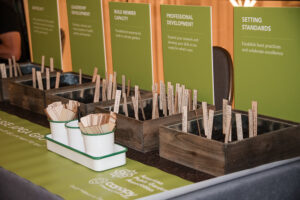
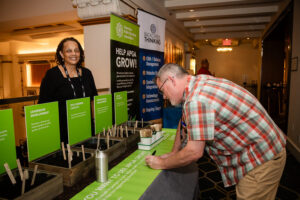
Credit to APGA’s photographer, Tom Bollinger, and our design partner, Gecko Group.
This process got me thinking about all the ways in which exhibit development and strategic planning overlap. Prior to joining Canopy’s team, I worked for 15 years as an exhibit developer, curator, and manager to create guest experiences — and I continue to use many of these exhibit ‘tools’ in my planning work now. Like any skills, these are learned, so I thought I’d share a few of them in hopes that there are nuggets you can adapt to your own work.
Consider Your Audience
Exhibition planning, like strategic planning, is an exercise in listening. Part of being a good listener is knowing whom you need to hear from and what ‘language’ they speak. In this case, we knew we had a group of garden leaders, horticulturalists, and all-around plant nerds. Plant tags felt like a familiar object that, when out of place in a hotel hallway, would get people to stop, investigate, and engage.
For strategic planning, developing the trust and rapport necessary to get people to talk isn’t just nice to have — it’s essential to the process. Stopping to think about whom you are asking for feedback and how best to get feedback from that group, on their terms, will reward you with thoughtful and usable input.
The Engagement Onion
Not everybody is a label reader. With any kind of engagement — exhibit, strategic planning, or otherwise — you have to invite participation from people at the level they prefer. For exhibits, that might mean ‘chunking’ content on labels for headline-only browsers or stand-awhile readers. (The latter is my father: visit a museum with him and he will still be reading labels when you’re long done and browsing the gift shop.)
Figuring out how to engage your audience also means considering the multiple types of experiences that people may want to have within an exhibit: physical, emotional, cognitive, etc. If you’re interested in the different motivations that drive people to visit exhibits, I recommend reading Identity and the Museum Visitor Experience by John H. Falk. This is a relevant book for anyone working within a cultural organization — museum or otherwise.
At the APGA conference, our interactive table was the core data collection method because it was the most flexible in terms of engagement level: you could leave a written response, ‘plant’ your idea and walk away — or stay awhile to talk to a Canopy team member. To reach different engagement levels, we also held longer-form focus groups and a short-form (but data-rich) live poll during one of the lunches.
During other strategic planning engagements with our clients, we plan out multiple tools and points of contact to allow for input at different moments and levels of intensity throughout the project. If you’re tackling a similar process, think about how you can break out of a one-size-fits-all engagement approach — yes, it’s more work, but your data will be richer for it.
Sounds Great, But Will It Work?
Folks do a lot of dreaming during strategic planning — we all want to imagine the best possible future of an organization so that we can figure out how to get there! Often the hardest question we have to ask during the process is: Can we actually do this? Exhibits are the same way; there’s often a wild, beautiful concept that we just know will make an impression on guests…as long as we can figure out how to build it.
When we were designing our table for the conference, we had to ask questions like:
- Is there enough surface area on the plant stake for people to write?
- How can we make the plant stakes stand up so you can see them? (Spoiler: dirt was the answer.)
- Will the hotel staff let me check in with a bag of topsoil alongside my luggage? (They did!)
In the ideation phase, there were lots of intriguing concepts that we loved, but ultimately discarded for this interactive because they were impractical. They weren’t bad ideas; they just didn’t work at this time, in this context, with the time and resources we had at hand. Strategies you commit to in your strategic plan have to be the same: contextual, tangible, achievable, and still wild enough to get people excited.
—
Ultimately, these techniques are all about engaging people thoughtfully, with consideration for their interest, comfort level, and lived experience. When done right, exhibits and strategic plans are both singular visions built from collective input. I see my role as the facilitator in strategic planning as being very much the same as the one I played as an exhibit developer: to ask the right questions, translate the answers across different groups, and build consensus that allows us to identify that shared vision.
What tools or tricks have you picked up from other spaces or lived experiences that have helped you get the input you needed for successful planning? I’d love to hear them.
And if you’d like to talk to us more about strategic planning, we’d love to chat.
— Anna Musun-Miller, Director of Planning