Strategic plans are full of bold visions and ambitious goals, but without the financial foundation to support them, they remain just that: ambitious, not necessarily achievable. Aligning mission and margin means that every strategic decision must be backed by solid economic data and modeling.
Lauren Haskins, Canopy’s Business Analytics Manager, plays a crucial role in this process. Her work helps cultural institutions understand their financial history, project their future, and make informed decisions about everything from pricing strategies to capital investments.
Here’s how she transforms organizational data into actionable insights:
Building the Foundation: Historical Operating Models
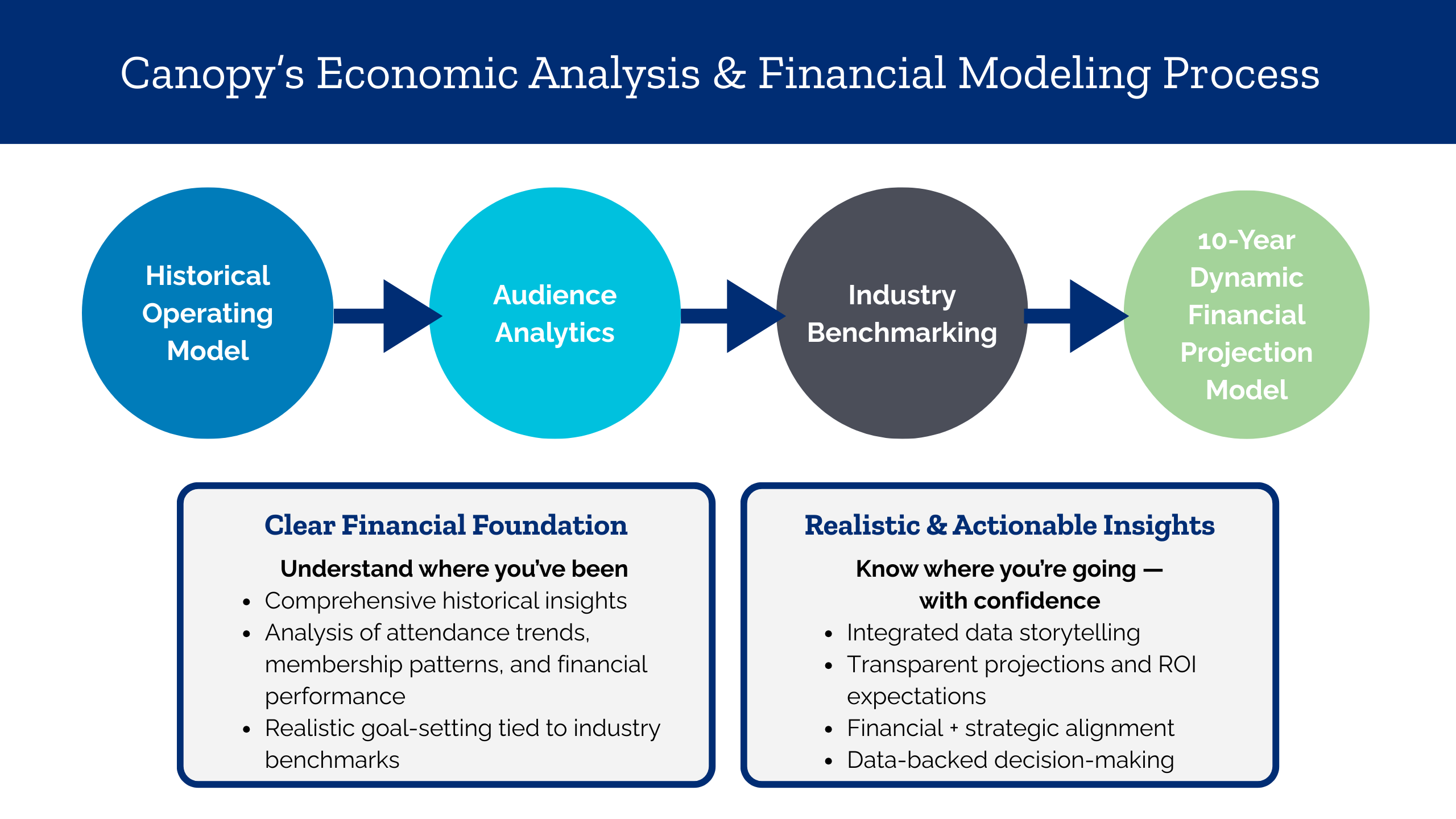
Every Canopy client engagement begins with understanding where an organization has been. The first order of business is to create a Historical Operating Model: a comprehensive analysis that examines six years of organizational data, including attendance trends, membership patterns, and financial performance.
This isn’t just about plugging numbers into spreadsheets. Lauren analyzes line items to understand the story behind the data, such as:
- How have attendance trends impacted revenue?
- Did price increases cause any membership fallout?
- How has the organization rebounded (or not) from COVID-19’s impact?
The Historical Operating Model becomes the launching point for everything that follows in a planning process. It provides a snapshot of where the organization stands and sets up conversations about what’s next.
The Value of Deep Industry Knowledge
One of the most valuable aspects of Canopy’s work is the industry expertise that our Economics experts bring to every project. Through years of working with hundreds of cultural institutions, they’ve developed benchmarks that aren’t publicly available anywhere else.
These insights help organizations understand how they’re performing relative to peer institutions. For example, botanical gardens typically aim for membership capture rates between four and six, while zoos and aquariums may have different benchmarks. Knowing where you stand compared to industry standards helps with identifying areas for improvement and setting realistic goals.
“Our clients can look at this data and say: ‘Oh, okay, so we’re behind on that. How do we get that number up? Or — why is that trend happening?’ Those are cool moments to see that people are interested to have that data where it’s not publicly available somewhere.”
Where Data and Strategy Converge
Lauren’s work doesn’t happen in isolation. She collaborates closely with Sydney Williams, Canopy’s Market Analyst, to ensure that audience analytics and financial data tell a cohesive story. If Sydney sees unusual patterns in attendance data, Lauren can cross-reference with financial records to understand what’s driving those trends.
This integrated approach means clients receive a complete picture rather than disconnected reports. The market analysis informs the financial projections, and the financial data validates the audience insights.
The Econ team is also exploring innovative ways to present this integrated data through interactive dashboards that would allow clients to manipulate variables and see real-time impacts on their projections, turning static reports into dynamic planning tools. (Stay tuned for more on that this year!)
From Strategic Plans to Financial Projections
After the initial analysis phase, Lauren returns to the planning process near the end to build 10-year financial projection models. This is where strategic plans become tangible, quantifiable futures.
Working closely with the project leads, Lauren incorporates strategic plan goals, master plan concepts, or business plan scenarios into dynamic projection modeling. If a client is considering a $20 million capital investment, the projection model shows the anticipated impact on attendance, revenue, and net income over a decade.
Notably, these projections aren’t designed to tell clients what they want to hear. Sometimes the data reveals that a proposed investment may not generate the returns expected. This level of transparency allows organizations to make informed decisions based on realistic expectations.
“We’re not just here to tell people what they want to hear. We’re here to share our expertise and what we believe is going to happen. Hopefully, that allows the client to make an informed decision based on the data that we’re providing them.”
Case Study: Land Between the Lakes
A recent project with Land Between the Lakes — a national recreation area located in Kentucky — exemplifies how integrated planning works in practice. Lauren had the opportunity to attend strategic planning sessions in which local fifth graders and community stakeholders brainstormed concepts for the Children’s Forest.
Being on-site during these creative sessions gave Lauren invaluable context:
“I could see the spaces, understand the roadblocks, and hear firsthand what stakeholders envisioned. When it came time to build the financial projection model, I wasn’t just plugging in abstract concepts — I was modeling ideas that I had watched develop.”
The team modeled three concepts: an elevated children’s campground with treehouse structures, an accessible playground, and a Forest 101 orientation program. And the financial analysis backed up the viability — these investments wouldn’t drain their budget, but would actually generate modest revenue. Our projections gave them the go-ahead to move forward with confidence.
Why Integrated Planning Works
Lauren’s background working with federal funding and programmatic objectives prepared her well for Canopy’s integrated approach. She understands that financial planning and strategic planning aren’t separate tracks — they’re two sides of the same coin.
When economic analysis happens alongside strategic planning, the financial projections feel more connected to the decision-making. Lauren can better understand how the organization arrived at its goals and model scenarios that clearly reflect the client’s vision and constraints.
Through historical analysis, industry benchmarking, integrated data storytelling, and dynamic financial projections, our Economics team gives mission-driven organizations the clarity and confidence to make strategic decisions that will have guests walking through their gates for years to come. They show not just what’s possible, but what’s sustainable.
At the end of the day, there is no mission without margin — and there’s no margin without the data to back it up.
Lauren Haskins is a Business Analytics Manager on Canopy’s Economics team, specializing in financial modeling, historical data analysis, and dynamic projection modeling for cultural institutions. Learn more about our Economics services here.